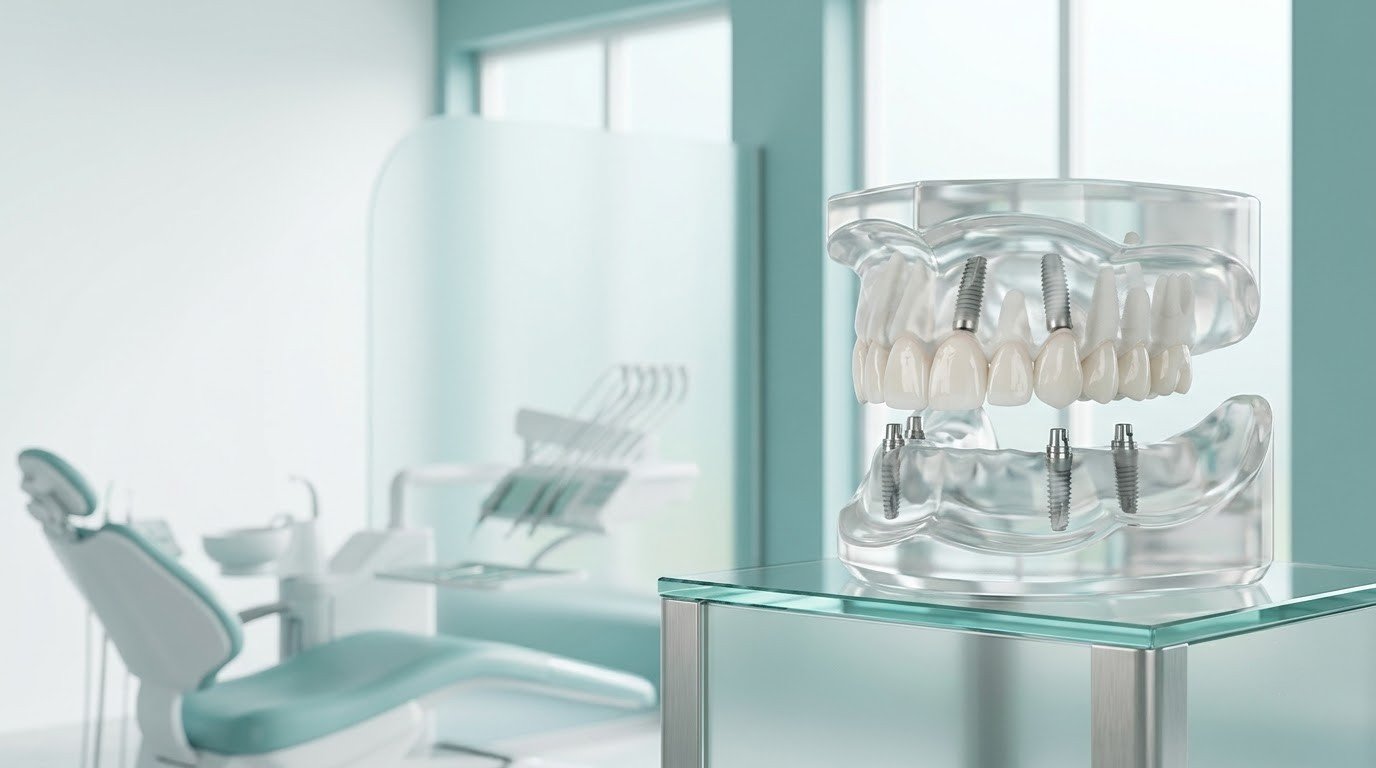
All-on-6 uses six implants per arch and typically costs about $3,000–$8,000 more than All-on-4, which uses four. In one 2026 clinic benchmark, All-on-4 runs about $20,000–$30,000 per arch and All-on-6 about $24,000–$38,000. All-on-6 adds support and backup, while All-on-4 can work well with less bone and a lower price.
Key takeaways
- The main differences are implant count, price and how chewing force is spread.
- All-on-6 offers redundancy, because the bridge may remain supported if one implant fails.
- All-on-4 can avoid grafting in many cases by angling the back implants.
- Your 3D scan, bite and bone decide the right design, not price alone.
💡 Planning your dental budget? Use our free Dental Implants Cost Calculator to estimate your out-of-pocket costs by state in under a minute.
How do All-on-4 and All-on-6 compare side by side?
| Factor | All-on-4 | All-on-6 |
|---|---|---|
| Implants per arch | 4, back two often angled | 6, spread along the arch |
| Cost per arch (clinic benchmark) | $20,000–$30,000 | $24,000–$38,000 |
| Cost per arch (reported ranges) | $11,640–$27,500 | Higher than All-on-4 in the same benchmark |
| Bone needed | Can work with less bone | Usually needs enough bone for more implants |
| Chewing support | Good for most patients | More support, especially in the back |
| If one implant fails | Bridge may lose support | Remaining implants may still carry the bridge |
| Surgery time | Shorter | Longer |
How much more does All-on-6 cost?
One 2026 clinic-level benchmark puts the premium at about $3,000–$8,000 per arch, reflecting two extra implants, more surgical time and a larger prosthesis. Different datasets measure different things, so compare numbers within one source rather than mixing averages from several. See the full breakdowns in All-on-4 cost and All-on-6 cost. A 3-on-6 option, which uses six implants but a shorter bridge, is reported at about $9,700–$24,100 per arch.
Which gives better bite support?
More implants spread chewing force across more anchor points, which can help people with strong bites or a history of grinding. One clinic benchmark also notes that implants placed further back send force directly into an implant, which supports back-tooth chewing. All-on-4 is designed to handle normal function well, and many patients do very well with it. A night guard is often recommended for either design.
What role do bone and anatomy play?
All-on-4 tilts the back implants to use available bone and sometimes avoid grafting or the sinus. All-on-6 usually needs enough bone to place more implants, especially in the upper jaw, where a bone graft or sinus lift can add cost. Read bone grafting costs and sinus lift costs if your scan shows bone loss.
How do I choose?
- Get a 3D scan and a written plan for both options.
- Ask your dentist why they recommend four or six implants for your bone and bite.
- Compare itemized quotes, including extractions, grafting, sedation and the prosthesis material.
- Consider the budget and any financing, using our financing guide.
For the whole picture of both arches, read full-mouth cost without insurance.
Dental Implants Cost Calculator
Calculate your customized dental implant costs in seconds before visiting a dental office. Choose your US state, tooth location, implant brand, and restoration type (single tooth, All-on-4, All-on-6, or full mouth) with complete itemized pricing.
Launch Dental Implants Cost Calculator →All-on-4 vs All-on-6: frequently asked questions
What is the difference between All-on-4 and All-on-6?
All-on-4 supports a fixed arch on four implants, while All-on-6 uses six. All-on-6 adds support and redundancy and costs more, and All-on-4 can work with less bone at a lower price.
Is All-on-6 better than All-on-4?
Not always. All-on-6 can suit strong bites and adequate bone, while All-on-4 works well for many patients and costs less. Your 3D scan and bite determine the better design.
How much more does All-on-6 cost?
About $3,000–$8,000 more per arch in one 2026 clinic benchmark, with All-on-4 at roughly $20,000–$30,000 and All-on-6 at about $24,000–$38,000 per arch.
Which needs more bone?
All-on-6 usually needs enough bone for six implants, while All-on-4 uses angled back implants to work with less bone. Grafting or a sinus lift may be needed for either.
What happens if an implant fails?
With six implants, the bridge may still be supported by the remaining ones. With four, losing one can affect stability, and your dentist may need to replace the implant or adjust the bridge.
Does insurance cover either option?
Rarely in full. Most plans treat full-arch implants as elective, though some cover extractions, grafts or the prosthesis at about 50% up to an annual maximum, often $1,000–$2,000.
Keep reading
Sources and how we calculated these numbers
Ranges come from published 2026 US benchmarks, rounded for planning. Figures differ by data source, so we compare within one benchmark where possible. Last reviewed October 21, 2026. See our methodology.