A single dental implant in the US typically costs about $3,000–$6,000 all-in, covering the implant post, abutment and crown, and 2026 cost roundups put the average near $4,500. A full arch on four implants commonly runs about $11,600–$27,500 per arch, and a full-mouth restoration can reach $38,600–$90,000.
Key takeaways
- Always ask for the all-in price. Some advertised implant fees cover only the surgical post, not the abutment or crown.
- Extras such as extraction, bone grafting, sedation and 3D imaging can add a few hundred to several thousand dollars.
- Location matters. One 2026 state dataset puts the average single implant at $3,759 in Alabama and $5,733 in California.
- Insurance rarely pays for the whole treatment, and annual maximums of about $1,000–$2,000 are common.
- Modern implants show about 96% survival at 10 years in a 2019 systematic review, so many people weigh cost over time, not just the sticker price.
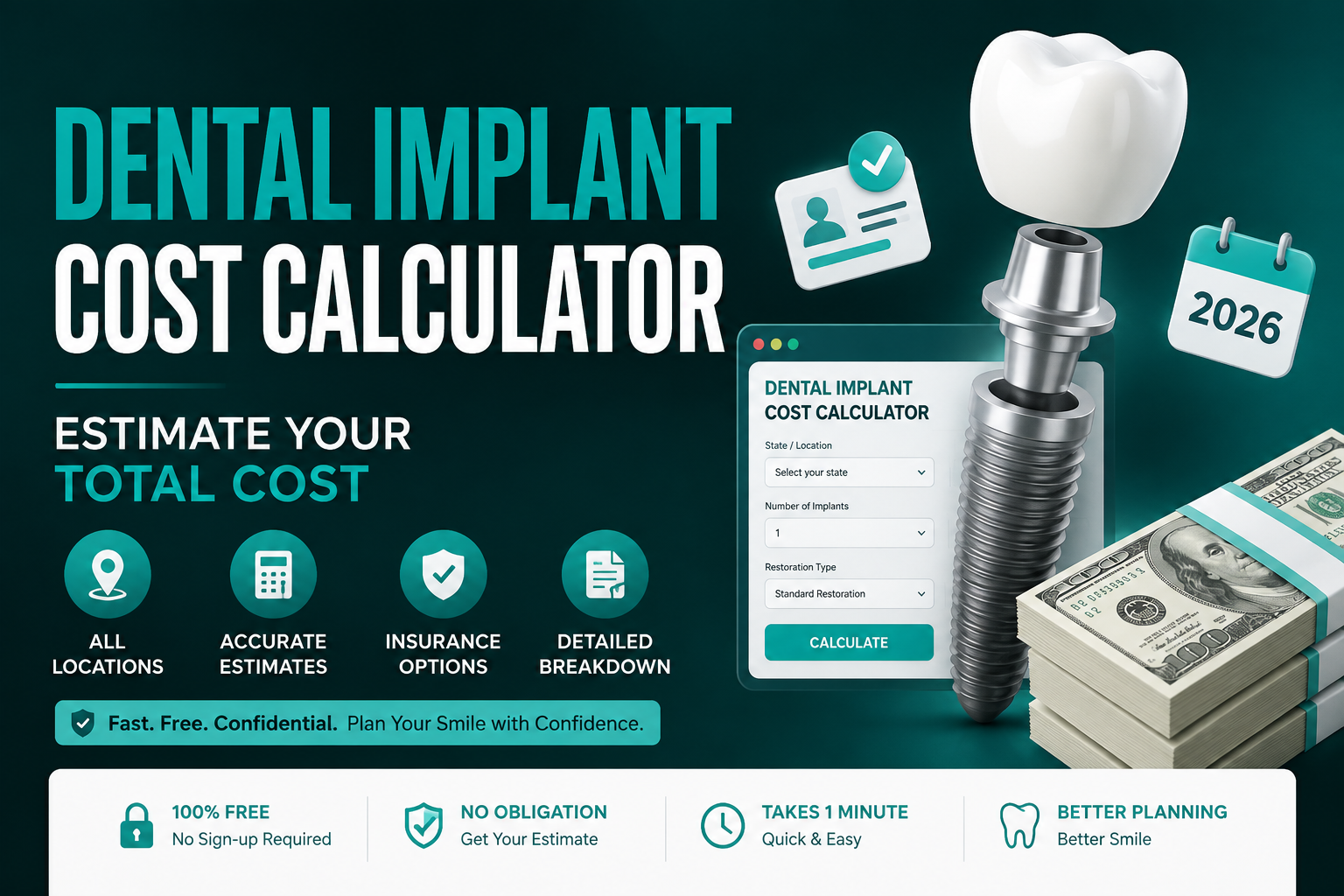
💡 Planning your dental budget? Use our free Dental Implants Cost Calculator to estimate your out-of-pocket costs by state in under a minute.
How much do dental implants cost by treatment type?
The right comparison is the treatment plan, not a single product price. A single missing tooth, a row of teeth and a full arch are priced very differently. These are 2026 US planning ranges from published cost benchmarks, rounded for budgeting.
| Treatment | Typical cost | What it replaces |
|---|---|---|
| Single-tooth implant | $3,000–$6,000 | One missing tooth, with post, abutment and crown |
| Implant-supported bridge | $4,000–$16,000 | Several adjacent teeth on two or more implants |
| Implant-retained denture | About $7,600–$13,300 per arch; mini-implant systems $2,000–$5,000 | A removable denture that snaps onto implants |
| All-on-4 (per arch) | $11,600–$27,500 | A full arch of teeth on four implants |
| Full-mouth restoration | $38,600–$90,000 | Both arches |
For a deeper look at one tooth, see our guide to single-tooth implant cost. For full arches, read about All-on-4 cost and full-mouth implants without insurance. If you are weighing removable options, compare implant-supported and traditional dentures.
What should a single-tooth implant price include?
A complete single-tooth treatment has several parts, and they may be billed together or separately:
- Exam and imaging: a clinical exam and, often, a 3D scan to plan placement.
- Surgical placement of the implant post: billed with procedure code D6010.
- Healing time: the post bonds with the jawbone over several months.
- Abutment: the connector, for example code D6056 for a prefabricated abutment.
- Crown: the visible tooth, for example code D6058 for an abutment-supported ceramic crown.
- Follow-up visits: checks after surgery and after the crown is placed.
One national cost dataset notes that a price quoted as simply an implant usually means the post alone, with the abutment and crown billed on top. That is why two quotes can look far apart and still cover different things. Material choices also move the price: a zirconia post or crown can add roughly $500–$1,500 to a single-tooth case.
How much do dental implants cost by state?
Dental fees follow local costs. A 2026 state-by-state dataset found average single-implant prices tracking each state’s cost of living closely, and that is the pattern most patients see in real quotes.
| Comparison | Typical single-implant price |
|---|---|
| Lowest state average in one 2026 dataset (Alabama) | $3,759 |
| Highest state average in the same dataset (California) | $5,733 |
| Rural practice vs. coastal urban market (one published example) | About $3,000 vs. about $5,500 |
Your own quote will depend on the practice, the specialist and what is included. Browse our dental implant cost by state guide, or pick your state in the free calculator to adjust the estimate.
What add-ons raise the total cost?
Many people need more than the implant itself. These items are often separate line items, so ask whether each one applies to you.
| Add-on | Typical cost | Notes |
|---|---|---|
| Tooth extraction | $150–$500 | Surgical extractions cost more than simple ones |
| Bone graft | $500–$3,500 | Only if the site needs rebuilding |
| 3D imaging and planning | $100–$700 | Higher when a surgical guide is included |
| Sedation | $250–$800 | Local anesthesia is usually included |
| Zirconia upgrade | About $500–$1,500 | Metal-free option, billed by material |
Adding those pieces to the $3,000–$6,000 base gives realistic totals for a single tooth:
| Scenario | Estimated total |
|---|---|
| Implant, abutment and crown only | $3,000–$6,000 |
| Plus extraction | $3,150–$6,500 |
| Plus extraction and bone graft | $3,650–$10,000 |
| Plus extraction, graft, 3D planning and sedation | $4,000–$11,500 |
These totals add the component ranges, so treat them as budgeting guides, not quotes. Related guides: bone grafting and implant cost, sinus lift and implant cost and same-day extraction and implant cost.
Does dental insurance cover implants?
Usually only in part. Many plans cover extractions or the crown more readily than the implant surgery, and some exclude implants entirely. Annual maximums of about $1,000–$2,000 are common, so coverage can run out quickly, along with waiting periods and deductibles.
Ask your dentist which procedure codes they will bill, such as D6010 for placement, D6056 for the abutment and D6058 for the crown, and request a written pre-authorization so you know your share before treatment. You can also pay with HSA or FSA funds. Our guide to dental implant cost with insurance walks through how coverage works.
6 ways to lower the cost of dental implants
- Get 2–3 itemized quotes that list the post, abutment, crown, imaging, extraction, graft and sedation separately.
- Ask what is bundled, such as a temporary tooth, follow-up visits and any warranty.
- Check dental school clinics, where supervised students and residents often charge less.
- Use HSA or FSA funds to pay with pre-tax dollars.
- Compare financing carefully. Try our financing calculator and read our guide to implant loans and payment plans.
- Be wary of ultra-low prices. A very low fee often covers only the post, not the abutment, crown or imaging. See ways to reduce your total cost.
Are dental implants worth the cost?
Implants have a strong long-term record. A 2019 systematic review of studies with at least 10 years of follow-up estimated implant-level survival at about 96%. Survival is not the same as trouble-free: crowns can wear or loosen, and gum disease around an implant can cause problems, so upkeep is part of the real cost.
Compared with a bridge, which relies on neighboring teeth, or a removable denture, an implant replaces the tooth root and helps keep the bone in place. Whether that is worth the price depends on your health, your budget and what your dentist recommends. Read our fuller take in are dental implants worth the cost and plan for maintenance and long-term costs.
Questions to ask before you pay
- What is the all-in price from exam to final crown?
- Is the quote itemized, and which items are optional?
- Are imaging, extraction, grafting and sedation included?
- Which implant brand and crown material are you using?
- Is a temporary tooth included?
- What is the warranty if the implant fails to bond?
- Will you submit a pre-authorization to my insurer?
See our full checklist of questions to ask before paying for dental implants and our guide to reading a dental implant quote.
Risks and warning signs
Implant surgery is common and generally safe, but complications can happen. The implant may fail to bond with the bone, the gums can become infected or recede, and smoking, uncontrolled diabetes and gum disease raise the risk. Follow all aftercare instructions and keep your cleaning and checkup schedule.
Contact your dentist promptly if you have a fever, swelling that worsens after the first few days, heavy bleeding, severe pain that medication does not control, or a loose implant or crown.
Keep reading: related dental implant guides
Dental Implant Cost by State (50-State Guide)
State-by-state regional cost multipliers and fee variations across the US.
Read article →Single-Tooth Dental Implant Cost Breakdown
Transparent breakdown of surgical post, abutment, and crown expenses.
Read article →All-on-4 vs. All-on-6 Cost & Differences
Compare load distribution, stability, and pricing between full-arch options.
Read article →Dental Implant Financing, Loans & Payment Plans
Monthly payment calculations, third-party healthcare loans, and 0% APR plans.
Read article →Dental Implants Cost Calculator
Calculate your customized dental implant costs in seconds before visiting a dental office. Choose your US state, tooth location, implant brand, and restoration type (single tooth, All-on-4, All-on-6, or full mouth) with complete itemized pricing.
Launch Dental Implants Cost Calculator →Dental implant cost in the USA: frequently asked questions
How much does a dental implant cost in the USA?
A single dental implant in the US typically costs about $3,000–$6,000 when the quote includes the implant post, abutment and crown, with 2026 cost roundups placing the average near $4,500. Extraction, bone grafting, sedation and 3D imaging are often separate and can raise the total.
Why are dental implants so expensive?
An implant is a surgical procedure plus custom components: a titanium or zirconia post, an abutment and a lab-made crown, supported by imaging and follow-up care. Specialist training, materials, laboratory work and local overhead all feed into the fee.
Does the advertised price usually include the crown?
Not always. Some quotes list only the surgical placement of the post, while the abutment and crown are billed separately. Ask for the all-in price from consultation to final crown and confirm what is itemized.
How much do full-mouth dental implants cost?
Published 2026 benchmarks put All-on-4 style treatment at about $11,600–$27,500 per arch and a full-mouth restoration at roughly $38,600–$90,000, depending on the number of implants, the prosthetic material, extractions and the provider.
Does dental insurance cover implants?
Sometimes in part. Many plans cover extractions or the crown more readily than the implant itself, and annual maximums of about $1,000–$2,000 are common. Ask for a written pre-authorization using the procedure codes your dentist will bill.
Which states have the cheapest dental implants?
In one 2026 state-by-state dataset, Alabama had the lowest average single-implant price at $3,759 and California the highest at $5,733. Prices tend to follow local cost of living, so rural areas are often lower than coastal metros.
Are very cheap dental implants safe?
Be cautious with prices far below the typical range. A low advertised fee often covers only the post and not the abutment, crown, imaging or extraction. Compare itemized quotes, ask about warranties and follow-up care, and confirm the provider’s implant training.
How long do dental implants last?
Modern implants have high long-term survival: a 2019 systematic review of studies with at least 10 years of follow-up found about 96% survival at the implant level. The crown may need replacement sooner than the post, and results depend on oral hygiene, gum health and habits such as smoking.
Can I finance dental implants?
Yes. Many practices offer payment plans or third-party financing, and you can pay with HSA or FSA funds. Compare the APR, fees, term and total repayment, not just the monthly payment.
Keep reading
Sources and how we calculated these numbers
Ranges on this page combine published 2026 US cost benchmarks with the planning ranges used in our calculator, rounded for planning. Scenario totals are the sum of the component ranges. Survival figures come from a published systematic review. We update this page when pricing data changes. Last reviewed October 21, 2026. See our full methodology.
- NewMouth: Types of Dental Implants and How Much Each One Costs (2026)
- Pearl Dental Costs: Dental Implants (D6010) national cost data
- Real Dental Costs: US Dental Cost Index by State (2026)
- Journal of Dentistry (2019): Long-term (10-year) dental implant survival, systematic review and meta-analysis
- American Dental Association: MouthHealthy (patient information)
- American Academy of Periodontology (patient information)